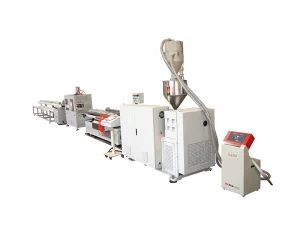
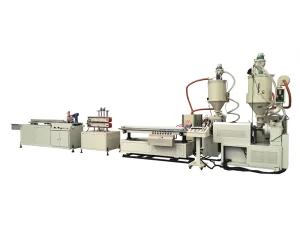
Technical clarifications on metallurgical design, dimensional control, and process parameters.
Q1: Why is Hastelloy C276 mandatory for FEP, PFA, and PVDF extrusion?
+
At processing temperatures between 300°C and 390°C, fluoropolymers release trace amounts of highly corrosive hydrogen fluoride (HF) gases. Traditional nitrided steel or standard stainless steel will quickly pit, erode, and contaminate the melt with metallic impurities. Hastelloy C276 offers high nickel-chromium-molybdenum resistance, ensuring chemical stability and keeping the line clean.
Q2: What techniques are used to achieve a ±0.02mm outer diameter tolerance?
+
We employ a three-tier control system: first, a high-torque melt pump is integrated downstream of the extruder to smooth out pressure surges. Second, a dual-axis laser diameter gauge measures the tube size after sizing. Third, the PLC links these measurements to the servo-controlled puller speed and melt pump output in a closed loop, correcting deviations within milliseconds.
Q3: How does BAOD handle the low melt-strength of fluoropolymer tubing?
+
Fluoropolymers, particularly FEP, exhibit weak melt-strength during cooling. We resolve this by designing custom vacuum calibration cooling sleeves with fine air-pressure balances. This prevents the tube from collapsing or ovalizing while moving from the hot die head to the chilled vacuum water bath.
Q4: Can a single line extrude both FEP and PFA?
+
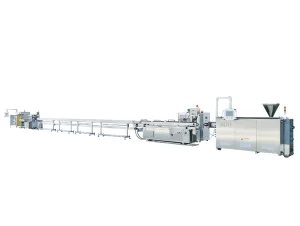
Yes. Since FEP and PFA share similar high-temperature extrusion characteristics, they can be processed on the same line. However, screw profiles and die tooling must be adjusted. FEP has a lower processing temperature (approx. 310°C - 350°C) than PFA (350°C - 380°C), which requires corresponding adjustments to the heating zone profiles.
Q5: What safety features are integrated into BAOD's fluorine plastic lines?
+
Our safety systems include over-pressure venting, alarm triggers on melt pump transducers, thermal overload containment zones, and toxic vapor extraction hoods mounted directly above the die head. This protects operators from inhaling harmful fluorinated off-gases.
 Baodie