Why Choose a Tube Extrusion Machine? The answer starts with the product itself: a long, continuous tube must hold its shape, dimensions, and surface quality. A Tube Extrusion Machine melts and pushes material through a shaped die, forming a steady profile. Downstream calibration, cooling, and cutting then help turn that profile into usable lengths. On a production floor, small details matter: resin moisture, melt temperature, line speed, and even the cleanliness of the die.
Extrusion specialist Dr. Chris Rauwendaal has written extensively about extrusion processes. A practical takeaway inspired by that field is: “Consistent output depends on controlling material flow, not chasing speed alone.” Treat that as a guiding principle, not a verified verbatim quotation. It captures an important buying question: can the line maintain stable dimensions during real production, not only during a short demonstration?
A suitable machine can support repeatable output, reduce manual handling, and accommodate different tube specifications when properly configured. Buyers should compare screw design, drive capacity, die options, cooling systems, controls, and maintenance access. Ask for sample runs using the intended material and dimensions. Measure the results. Look closely at wall thickness and surface finish. Still, the machine is not a cure-all. Poor material preparation or weak process control can undermine an expensive line. That deserves a second look. The best choice is the one that fits the product, operators, and production targets—not simply the machine with the largest output claim.
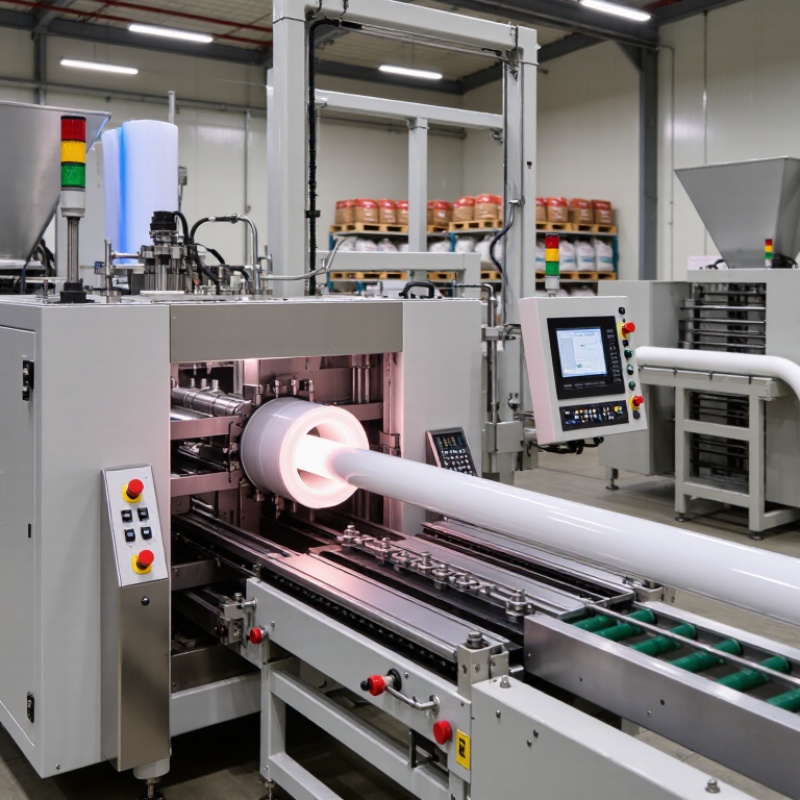
What a Tube Extrusion Machine Produces: Continuous Tubing and Profiles
Why Choose a Tube Extrusion Machine?
What a Tube Extrusion Machine Produces: Continuous Tubing and Profiles
A tube extrusion machine turns thermoplastic material into a continuous shape with a fixed cross-section. Pellets are heated and mixed inside a barrel, then pushed through a die that forms the material into a tube or profile. The result may be a simple round tube, a hollow channel, or a more complex section with ribs and grooves.
The line keeps the softened material moving through cooling and sizing equipment. A vacuum sizing tank can help hold the tube’s outer dimensions, while cooling water firms the shape. A haul-off unit pulls the product forward at a controlled speed, and a cutter trims it to length when needed. Small changes matter. Temperature, pull speed, and cooling can affect wall thickness and surface finish, so operators check measurements during production rather than relying on the first sample.
This process is useful when a project needs long, consistent lengths, such as tubing for fluid handling or profiles for frames and edge trims. The die determines the cross-section, but it does not guarantee a perfect result on its own. Material behavior, equipment settings, and cooling conditions all play a part. In practice, setup can take adjustment, and even a well-tuned line may need attention when dimensions change. That is worth planning for.
How the Line Works: Feeding, Melting, Die Forming, and Cooling
A tube extrusion line turns plastic pellets into a continuous profile through controlled feeding, melting, shaping, and cooling.
Pellets enter a hopper, where a feeder meters them into the heated barrel. Consistent feed matters: surges can affect wall thickness and surface quality. Small changes show up quickly.
Inside the barrel, a rotating screw moves and melts the material through heat and friction. Operators monitor temperature, screw speed, and melt pressure because settings interact. The molten plastic then passes through an annular die, which forms the tube’s diameter and wall. A die that is slightly off can create uneven walls, even when the rest of the line runs steadily.
The soft tube enters a sizing and cooling section, often supported by vacuum and cooled water. Cooling must be even; otherwise, the tube may warp or shrink unevenly. A haul-off pulls the profile at a controlled speed, and a cutter trims it to length. It sounds straightforward. In practice, startup adjustments take patience, and a clean cut does not prove every dimension is correct. Samples should be checked along the run, especially after material or speed changes.
Which Polymers and Tube Designs Suit Extrusion Processing?
Tube extrusion works best with thermoplastics that soften predictably, flow through a die, and hold their shape as they cool. Common options include polyethylene (PE), polypropylene (PP), PVC, and flexible materials such as thermoplastic polyurethane (TPU), depending on the tube’s intended use. Some nylon and polycarbonate grades can also be extruded, but they may require tighter temperature control and careful moisture management. Material selection should account for flexibility, heat exposure, chemical contact, and dimensional stability. Small changes in additives can affect the finish and feel. Easy to overlook.
Extrusion suits long tubes with a consistent cross-section, including straight tubing, protective sleeves, conduits, and capillary tubes. Multi-lumen designs and tubes with coextruded layers are possible, though they place greater demands on the die and cooling setup. Thin walls and narrow tolerances need careful control of melt pressure, cooling, and haul-off speed. A tube can look round at the die and become oval as it cools. Check cut sections for wall variation, not just outside diameter. Abrupt changes in wall thickness or built-in features may require secondary processing, so test the design early.
Why Choose a Tube Extrusion Machine?
Typical melt-processing temperature windows show why extrusion is suitable for thermoplastics that can be continuously softened, shaped, cooled, and calibrated. Flexible, rigid, multilayer, corrugated, and reinforced tubes can be produced by selecting the appropriate die, sizing system, and downstream equipment.
LDPE and HDPE are commonly selected for flexible and semi-rigid tubing, while PP supports higher-temperature applications. PVC is widely used for rigid or flexible tubes when stabilised formulations and controlled processing are applied. TPU is suitable for flexible, abrasion-resistant, and medical-style tubing. Actual settings depend on grade, additives, wall thickness, die design, and cooling conditions.
How to Compare Machine Performance: Output in kg/h and Dimensions in mm
Why Choose a Tube Extrusion Machine?
When comparing tube extrusion machines, output in kg/h provides a practical starting point. However, rated capacity rarely matches every production condition. Material type, tube diameter, wall thickness, and die design can change the result. During factory trials, measure actual kilograms produced over a full hour. Short tests can hide temperature changes, startup waste, and unstable feeding. A clean number is not always a reliable number.
Dimensions in mm matter just as much. Check the machine length, width, and height, then measure your available floor space carefully. Leave room for cooling equipment, material loading, maintenance access, and safe operator movement. A compact machine may seem efficient, but crowded access can slow daily work. I have seen layouts look acceptable on paper and become awkward beside real storage racks. That detail deserves more attention.
Tips: Ask for output data using your intended material and tube size. Compare continuous production, not only peak kg/h. Record die dimensions, cooling length, screw diameter, and total line length in mm. Check electrical and water connections before installation. Request a trial sample, and inspect wall uniformity, surface finish, and dimensional stability. Do not trust every specification equally. Practical verification remains necessary.
Why Choose a Tube Extrusion Machine? — How to Compare Machine Performance: Output in kg/h and Dimensions in mm
| Typical Line Class |
Screw Diameter (mm) |
Indicative Output (kg/h) |
Typical Tube Applications |
Approx. Line Dimensions (L × W × H, mm) |
Comparison Consideration |
| Compact |
45 |
20–60 |
Small-diameter tubing and lower-volume production |
7,000 × 1,500 × 2,000 |
Smaller footprint; compare output at the required tube size and material. |
| Standard |
60 |
50–120 |
General-purpose plastic tube production |
9,000 × 1,800 × 2,200 |
Balance production capacity, changeover needs, and available floor space. |
| High-capacity |
75 |
100–220 |
Higher-volume production and larger tube sizes |
12,000 × 2,200 × 2,400 |
Check whether downstream cooling, haul-off, and cutting equipment can match the extruder. |
| Large production line |
90 |
180–350 |
Large-diameter or high-throughput tube production |
16,000 × 3,000 × 2,800 |
Allow for material handling, maintenance access, and the complete line layout. |
Note: Output and dimensions are indicative planning estimates, not specifications for a particular machine. Actual output depends on polymer type, tube diameter and wall thickness, screw design, tooling, and operating conditions. Confirm comparable figures with a supplier using the same material and product specification.
PVC Pipe Benchmark: ASTM D1785 Schedules 40, 80, and 120
Why Choose a Tube Extrusion Machine?
A tube extrusion machine offers steady control for manufacturing PVC pipe under ASTM D1785 requirements. It melts a measured PVC compound and forms a continuous tube through a calibrated die. Accurate temperature control matters. Excess heat can damage the material, while insufficient heat may create rough surfaces or weak weld lines. Vacuum calibration, cooling tanks, haul-off speed, and cutting length must work together. Small changes can affect wall thickness across the entire run.
ASTM D1785 covers PVC pipe in Schedules 40, 80, and 120. These schedules identify dimensional classes, not one universal pressure rating. Schedule 40 normally has the thinnest wall, while Schedule 120 has the thickest wall for the same nominal size.
However, pressure performance also depends on pipe diameter, temperature, compound quality, and test results. A larger pipe may not behave like a smaller pipe with the same schedule.
Quality teams should verify dimensions, appearance, hydrostatic performance, and marking against the current standard. Measure samples from the beginning, middle, and end of production. Do not trust appearance alone. A smooth pipe can still have uneven walls.
In practical extrusion work, operators often adjust cooling or haul-off speed after reviewing measurements. That judgment is useful, but it can introduce inconsistency. Automated control helps reduce this risk, although it does not replace inspection. The setup is never perfect. Good records reveal why.
Conclusion
A Tube Extrusion Machine is designed to produce continuous plastic tubing and profiles with consistent dimensions, smooth surfaces, and reliable output. The process begins by feeding polymer material into the machine, where controlled heat melts it before the material is pushed through a shaped die. After forming, the tube is calibrated and cooled to stabilize its size and appearance. This continuous production method supports efficient manufacturing for many applications.
Different polymers and tube designs can be selected according to flexibility, strength, temperature resistance, wall thickness, and intended use. When comparing equipment, key performance factors include output capacity in kg/h, dimensional range in mm, melt stability, cooling efficiency, and control accuracy. For PVC pipe production, schedules such as 40, 80, and 120 provide useful benchmarks because they represent different wall thicknesses and pressure capabilities. Choosing the right Tube Extrusion Machine depends on material compatibility, product specifications, production volume, and the level of dimensional consistency required.

 Baodie