Why Choose a Plastic Pipe Extrusion Line?

Time:2026-09-20 Author:Henry
0%

Plastic pipes support water distribution, drainage, irrigation, gas protection, and industrial processing. Their performance depends heavily on consistent manufacturing. This is where a Plastic Pipe Extrusion Line becomes valuable. It combines material feeding, melting, shaping, cooling, sizing, hauling, and cutting in one controlled process.

Grand View Research reported that the global plastic pipes market was valued at approximately USD 12.65 billion in 2023. Its analysis also projects a compound annual growth rate of about 4.7% from 2024 to 2030. These figures reflect continuing demand for lightweight, corrosion-resistant, and cost-efficient piping systems. A modern extrusion line can help manufacturers maintain stable wall thickness, accurate outer diameter, and reliable output. Small changes matter. A cooling tank set too warm may affect dimensional stability. An unstable haul-off speed can create uneven pipe thickness.

Material efficiency is another important consideration. PlasticsEurope reported global plastics production of about 413.8 million tonnes in 2023. This scale increases pressure on manufacturers to reduce waste and improve process control. A well-designed line can support recycled-content strategies, although recycled polymers require careful testing and controlled blending. The answer is not automatic.

Choosing equipment also requires practical judgment. Output capacity, resin type, pipe diameter, energy consumption, maintenance access, and applicable standards should be reviewed together. Operators often learn that the fastest line is not always the most economical line. Long-term reliability, documented quality procedures, and responsive technical support may matter more than a higher headline speed. For this reason, selecting a Plastic Pipe Extrusion Line should be based on verified production data, application requirements, and realistic operating experience.
Why Choose a Plastic Pipe Extrusion Line?

Plastic Pipe Extrusion Lines: Equipment, Functions, and Process Flow

Why Choose a Plastic Pipe Extrusion Line?

Plastic Pipe Extrusion Lines: Equipment, Functions, and Process Flow

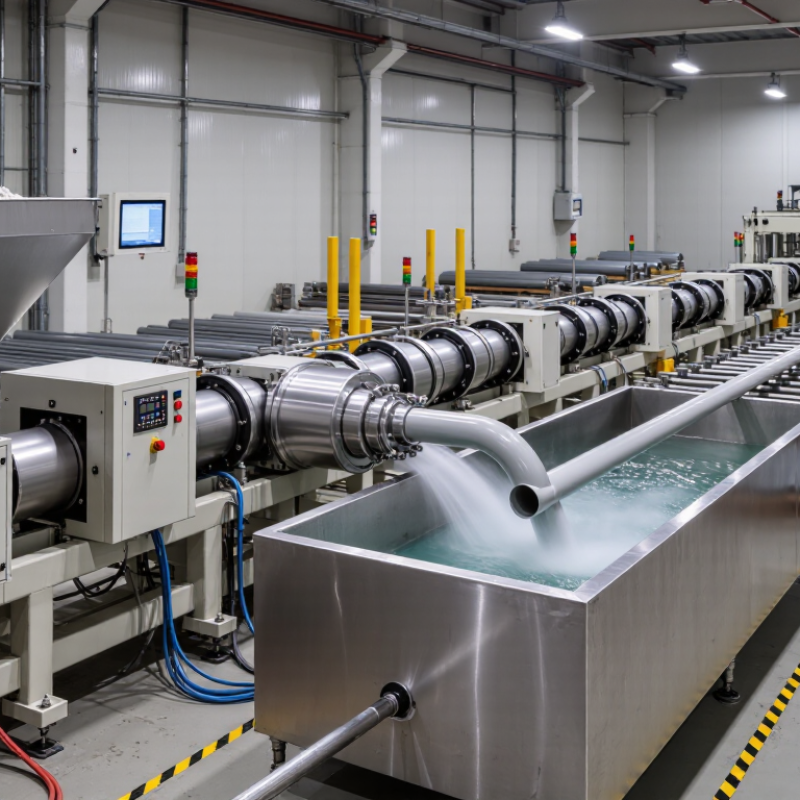
Plastic pipe extrusion lines convert polymer pellets into continuous, controlled pipe. Their value lies in coordinated equipment, not one machine. A typical line includes a hopper loader, gravimetric feeder, extruder, die, vacuum calibration tank, cooling tank, haul-off, cutter, and stacker. Each unit controls a different risk, from unstable feeding to oval pipe.

The process begins with measured material feeding. Inside the heated barrel, screws melt and mix the polymer. The die then shapes a uniform tube. Vacuum calibration fixes the outside diameter, while cooling tanks reduce distortion. Haul-off rollers maintain speed and tension. Finally, cutters or coilers prepare the pipe for handling. Small changes in melt temperature can affect wall thickness. This is where practical experience matters.

Industry data shows why reliable lines remain important. PlasticsEurope reported global plastics production of 400.3 million tonnes in 2022. Market reports from Grand View Research estimate continued growth in plastic pipe demand through the next decade, driven by water infrastructure, construction, and irrigation. However, published forecasts use different definitions and regions. They should not be treated as exact promises.

Energy use, scrap rate, and dimensional consistency deserve equal attention. Inline gauges can monitor diameter and wall thickness during production. Operators still need calibration checks and documented maintenance. No extrusion line is perfect. A poorly matched die can waste material quickly. A well-tuned line produces steady pipe, cleaner cut ends, and fewer interruptions.

Why Choose a Plastic Pipe Extrusion Line?

A plastic pipe extrusion line combines material feeding, melting, shaping, cooling, sizing, hauling, cutting, and collecting in one continuous process. The chart shows indicative, non-brand-specific output capacities commonly associated with different pipe outside-diameter ranges.

As pipe diameter increases, the line generally requires greater melt output, stronger cooling capacity, and higher haul-off performance. Actual production depends on the polymer, wall thickness, pipe standard, die design, and operating conditions.

Material Selection: PE100’s 10 MPa MRS Rating Under ISO 12162

Why Choose a Plastic Pipe Extrusion Line?

Material selection should guide every decision in a plastic pipe extrusion line. PE100 is classified under ISO 12162 with a 10 MPa Minimum Required Strength (MRS) rating. This value represents long-term hydrostatic strength at 20°C, using standardized testing and extrapolation. It is not the pipe’s working pressure.

In production, the extrusion line must maintain steady melting, accurate wall thickness, and consistent cooling. Small temperature changes can affect melt stability and surface quality. A reliable line also supports online diameter checks and regular pressure testing. These controls help confirm that the finished pipe matches its design requirements. However, PE100 alone does not guarantee performance. SDR, operating temperature, joint quality, and the selected design coefficient also matter. I have seen specifications become unclear when MRS is treated as a simple pressure number.

Tips: Check the resin documentation and ISO 12162 classification before production. Match the die, cooling system, haul-off speed, and cutter to the target pipe size. Keep test records for melt temperature, dimensions, and hydrostatic results. Do not rely only on visual appearance. It can look perfect. A practical review should also question whether the line can hold stable output during long production runs.

Extrusion, Calibration, and Testing According to ISO 4427 Requirements

Why Choose a Plastic Pipe Extrusion Line?

Extrusion, Calibration, and Testing According to ISO 4427 Requirements

A plastic pipe extrusion line should do more than produce a smooth surface. It must support controlled extrusion, accurate calibration, stable cooling, and traceable testing. ISO 4427 requirements guide key properties for polyethylene pipes used in water supply and pressure sewerage applications. Melt temperature, screw speed, and wall thickness require close attention. Small changes can create ovality, uneven dimensions, or weak sections.

During calibration, vacuum sizing helps control the pipe’s outside diameter. Cooling tanks then reduce thermal stress and support dimensional stability. Operators should record temperatures, line speed, pressure, and material batch details. Testing may include visual inspection, dimensional checks, hydrostatic strength, and resistance to internal pressure. The exact test plan should match the applicable ISO 4427 part and current project specification. A pipe can look perfect and still fail under pressure. That is an uncomfortable fact.

Tips: Keep calibration sleeves clean. Check gauges regularly. Verify wall thickness at several points around the pipe. Use documented sampling procedures, not memory. Allow enough cooling time before cutting or stacking. Experienced technicians often notice changes before instruments show a serious problem, but personal judgment should not replace recorded evidence. No line is perfect. Reviewing rejected samples can reveal patterns and improve settings. When results seem unusually good, test again rather than assuming the process is flawless.

Dimensional Accuracy: ASTM D3034 Standards for PVC Sewer Pipes

Why Choose a Plastic Pipe Extrusion Line?

Dimensional Accuracy: ASTM D3034 Standards for PVC Sewer Pipes

For PVC sewer pipes, dimensional accuracy begins inside the extrusion line. ASTM D3034 covers Type PSM PVC sewer and drain pipe, including outside diameter, wall thickness, and SDR requirements. These details affect joint fit, flow capacity, and resistance to external loads. A pipe may look smooth, yet a small wall-thickness variation can weaken its performance after installation.

A reliable extrusion line uses controlled feeding, centered die tooling, vacuum calibration, and stable cooling. Online laser gauges can monitor diameter continuously, while haul-off speed helps maintain consistent dimensions. Operators should also inspect socket dimensions and cut lengths, not only the pipe surface. ASTM D3034 testing includes requirements such as flattening, impact resistance, and extrusion quality. Production records make these checks traceable.

Numbers reveal why this control matters. The U.S. Environmental Protection Agency’s 2022 Clean Watersheds Needs Survey identified approximately $630.1 billion in wastewater infrastructure needs over twenty years. That demand increases pressure for durable, interchangeable sewer components. Still, automation is not a guarantee. A line can pass a quick check and drift after temperature changes. That uncomfortable gap deserves attention. Calibration routines, sampling frequency, and operator judgment remain important, even with modern sensors. An extrusion line chosen only for speed may create hidden dimensional costs. Consistency is the real advantage.

Service Life and Sustainability: 50-Year Design Basis and Material Recovery

A plastic pipe extrusion line supports more than continuous production. Its value is closely tied to service life, material control, and responsible recovery. A 50-year design basis can guide engineering decisions, but it is not a promise of unlimited performance. Pressure, temperature, soil movement, ultraviolet exposure, and installation quality all affect the result.

In practical production, stable extrusion helps maintain wall thickness and dimensional accuracy. Operators monitor melt temperature, cooling water, haul-off speed, and pressure during each run. Small variations can create weak points that remain invisible until years later. That risk deserves attention. A pipe designed for decades still needs correct handling, jointing, and inspection on site.

Material recovery also begins inside the factory. Clean start-up waste and approved offcuts can often return to controlled production streams. Sorting matters because mixed polymers, pigments, dirt, or metal fragments may reduce quality. Recovery is not automatically sustainable. Not always. Energy use, transport, reprocessing limits, and local recycling capacity must be assessed honestly. Some recovered material may suit non-pressure applications rather than critical pipelines. A reliable extrusion line makes these choices easier through consistent dosing, traceable batches, and repeatable process records. The result is a more realistic balance between long service life and responsible material use.

Why Choose a Plastic Pipe Extrusion Line? — Service Life and Sustainability: 50-Year Design Basis and Material Recovery

Evidence-based comparison of common thermoplastic pipe materials, long-term design principles, and end-of-life recovery considerations

Evaluation Dimension Evidence-Based Data or Benchmark Benefit of Plastic Pipe Extrusion Practical Design and Sustainability Consideration
Design Service-Life Basis Many thermoplastic pressure-pipe systems are assessed using a 50-year design basis. For polyethylene systems, long-term hydrostatic strength is commonly evaluated through extrapolation methods such as ISO 9080. A 50-year design basis supports long-term infrastructure planning and reduces the frequency of replacement compared with short-life applications. A 50-year design basis is a design assumption, not an unconditional guarantee. Actual service life depends on temperature, pressure, installation quality, chemical exposure, loading, and operating conditions.
Long-Term Temperature Effect Thermoplastics generally lose stiffness and pressure capability as operating temperature increases. Design calculations must use material-specific temperature derating factors. The extrusion process can produce consistent wall dimensions and controlled material formulations for the intended temperature range. Do not apply a room-temperature pressure rating to hot-water or industrial service without checking the applicable material standard and temperature rating.
Polyethylene Pipe Material Typical density: approximately 0.94–0.97 g/cm³. Polyethylene is lightweight, chemically resistant, and commonly joined by heat fusion. Low mass can reduce transport and handling requirements. Heat-fused joints can create a continuous, leak-resistant pipeline when properly prepared and controlled. Recycling quality is highest when polyethylene pipes are separated by polymer type, kept relatively clean, and processed through an appropriate mechanical-recycling route.
Polypropylene Pipe Material Typical density: approximately 0.90–0.91 g/cm³. Polypropylene offers low density and good resistance to many aqueous chemicals. Lower material density can support efficient material use and easier handling during production and installation. Recovered polypropylene should be identified and sorted separately from polyethylene and PVC because different polymers require different processing conditions.
Unplasticized PVC Pipe Material Typical density: approximately 1.35–1.45 g/cm³. PVC-U provides high ring stiffness and good resistance to many corrosive environments. High stiffness-to-cost performance can enable efficient wall designs for gravity drainage and other applications. PVC recovery is technically possible, but collection, sorting, contamination control, and separation from other PVC products strongly affect the quality and value of recycled material.
Corrosion Resistance Polyethylene, polypropylene, and PVC are generally resistant to many forms of soil-side corrosion and electrochemical corrosion that affect metallic pipes. Reduced corrosion risk can help maintain hydraulic capacity and limit premature replacement caused by rust or external corrosion. Compatibility must still be checked for hydrocarbons, strong oxidizers, concentrated acids or alkalis, and elevated temperatures.
Hydraulic Efficiency New thermoplastic pipe surfaces are generally smooth. Hydraulic performance is determined by internal diameter, roughness, flow regime, fittings, and aging conditions. Consistent extrusion control helps maintain the specified internal diameter and wall profile, supporting predictable flow calculations. Hydraulic design should use the relevant national or international calculation method rather than relying only on a generic roughness value.
Leak-Reduction Potential Joint performance depends on the selected system. Butt fusion and electrofusion can produce fused polyethylene joints; solvent cementing and elastomeric seals are used for some PVC systems. Fewer joints and correctly controlled joining procedures can reduce the number of potential leakage points. Installation training, surface preparation, alignment, temperature control, inspection, and pressure testing remain essential.
Material Efficiency in Extrusion Extrusion allows continuous production with controlled outside diameter, wall thickness, and concentricity. Multilayer and co-extruded structures may combine different functional layers. Process control can reduce dimensional variation and production scrap while matching material use to the required pressure or stiffness class. Multilayer products may require specialized separation or recycling routes. Product design should consider end-of-life compatibility before introducing additional layers or additives.
Production Scrap Recovery Clean, single-polymer start-up scrap and off-specification pipe can often be granulated and reprocessed where product standards permit. Internal scrap recovery can reduce virgin resin consumption and lower the amount of production waste sent for disposal. Reprocessing must be controlled for contamination, thermal history, color, additive content, and compliance with the intended pipe standard.
Post-Use Mechanical Recycling Clean PE, PP, and PVC pipe can be collected, sorted, size-reduced, and processed into recycled material. There is no single universal recovery rate because results depend on collection systems and contamination. A long service life followed by material recovery can preserve part of the polymer resource beyond the first application. Recovered resin may be suitable for non-pressure or lower-risk products unless testing and the applicable standard permit its use in pressure applications.
Energy Recovery and Disposal Hierarchy When mechanical recycling is not technically or economically feasible, some waste plastics may be used for energy recovery where permitted. Landfill is generally the least preferred option in a circular-material strategy. A defined end-of-life hierarchy helps manufacturers and infrastructure owners select the highest-value feasible recovery route. Local regulations, emissions controls, collection logistics, and available recycling infrastructure must be assessed before selecting the final route.
Environmental Product Assessment Life-cycle impacts depend on resin production, electricity mix, pipe weight, transport distance, installation method, service life, leakage performance, and end-of-life treatment. Extrusion-line data can support life-cycle assessment through measurements of material consumption, energy use, scrap generation, and recycled content. Comparisons should use the same functional unit, service conditions, design life, and system boundary; a lighter pipe is not automatically the lowest-impact option.
Quality-Control Indicators Typical controls include outside diameter, wall thickness, ovality, mass per unit length, hydrostatic performance, impact resistance, appearance, and joint compatibility. Online measurement and documented process control help maintain consistent production across long extrusion runs. Testing frequency and acceptance criteria should follow the applicable product standard and the intended application.
Overall Sustainability Rationale A durable pipe system can reduce replacement frequency, while clean production scrap and end-of-life pipe may be recoverable through mechanical recycling. The combination of long-term service, material efficiency, low corrosion susceptibility, and recoverability can support a lower whole-life impact. Sustainability claims should be verified with project-specific life-cycle data rather than based solely on material type or a nominal 50-year design basis.

Note: The values shown are general engineering ranges and principles for common thermoplastic pipe materials. Final material selection, pressure rating, wall thickness, service life, and recovery route should be verified against the applicable product standard, local regulations, operating conditions, and qualified engineering calculations.

FAQS

What does PE100’s 10 MPa MRS rating actually mean?

It indicates long-term hydrostatic strength at 20°C under standardized testing. It is not the pipe’s working pressure.

Why does an extrusion line need stable temperature control?

Small temperature changes can disturb melting, surface quality, and wall thickness. The pipe may look smooth. Hidden weakness can remain.

Which process controls help produce consistent pipe dimensions?

Monitor melt temperature, screw speed, cooling water, haul-off speed, and line pressure. Online diameter checks can detect changes early.

How does vacuum calibration support pipe production?

Vacuum sizing helps control the outside diameter during extrusion. Clean calibration sleeves improve consistency. Dirty equipment can create dimensional problems.

What testing should operators perform on finished pipes?

Checks may include appearance, dimensions, wall thickness, hydrostatic strength, and internal pressure resistance. The test plan should match the applicable standard and project requirements.

Does a perfect-looking pipe guarantee reliable performance?

No. A pipe can look perfect and still fail under pressure. Test records matter more than appearance alone.

Does a 50-year design basis guarantee fifty years of service?

No. It provides an engineering basis, not an unlimited-performance promise. Temperature, pressure, soil movement, ultraviolet exposure, and installation quality also matter.

Can production waste always return to new pressure pipes?

No. Clean, sorted offcuts may suit controlled recovery streams. Dirt, mixed polymers, pigments, and metal fragments can reduce quality. Some recovered material may fit non-pressure applications better.

Conclusion

A Plastic Pipe Extrusion Line is an integrated production system designed to manufacture reliable plastic pipes with consistent quality and controlled dimensions. The process typically includes material feeding, melting, extrusion, sizing, vacuum calibration, cooling, haul-off, cutting, and inspection. Material selection is essential: PE100 is recognized for its 10 MPa Minimum Required Strength rating under ISO 12162, making it suitable for demanding pressure applications. During production, extrusion, calibration, and testing can be organized to meet the performance and quality requirements outlined in ISO 4427.

For PVC sewer pipes, dimensional accuracy and structural consistency are key considerations, with ASTM D3034 providing relevant guidance for pipe requirements. A well-designed line helps maintain stable wall thickness, precise outside diameter, and dependable surface quality throughout continuous production. In addition to performance, plastic pipes can be evaluated using a 50-year design basis, supporting long-term infrastructure planning. Efficient processing and material recovery practices can also reduce waste and improve sustainability by allowing suitable production scrap and used materials to be recovered where appropriate.


Henry

Henry

Henry is a dedicated marketing professional with a profound expertise in the company's offerings. With years of experience in the industry, he possesses an impressive understanding of the market dynamics and consumer behaviors that drive success. Henry is committed to sharing his insights through......