A Plastic Extrusion Line can help a business turn resin into consistent profiles, tubing, sheets, or custom parts. The value is practical: a controlled process can reduce variation, support repeat production, and make output easier to scale. But the equipment is only one part of the decision. Material choice, screw design, die setup, cooling, and operator skill all affect the finished product.
Picture a profile leaving the die, passing through a water bath, then reaching the cutter at a steady pace. Small changes in temperature or puller speed can alter its dimensions. There is little room for guesswork. A practical takeaway from extrusion specialist Chris Rauwendaal’s technical writing can be paraphrased this way: “Reliable extrusion depends on matching the material, machine, and process conditions.” This is a paraphrase, not a verbatim quotation. It points to a useful buying question: can the proposed line handle your actual materials and tolerances, not just an attractive sample?
A line may promise speed, yet speed alone does not guarantee profitable production. Maintenance access, changeover time, energy use, and the availability of skilled support deserve equal attention. A plan can look tidy on paper and still miss a maintenance bottleneck. That deserves a second look. This guide will examine the main business reasons to invest, the costs and trade-offs to assess, and the questions to ask suppliers. Its aim is not to make every operation sound like a perfect fit. The right choice depends on your product, production volume, and capacity to run the process well.
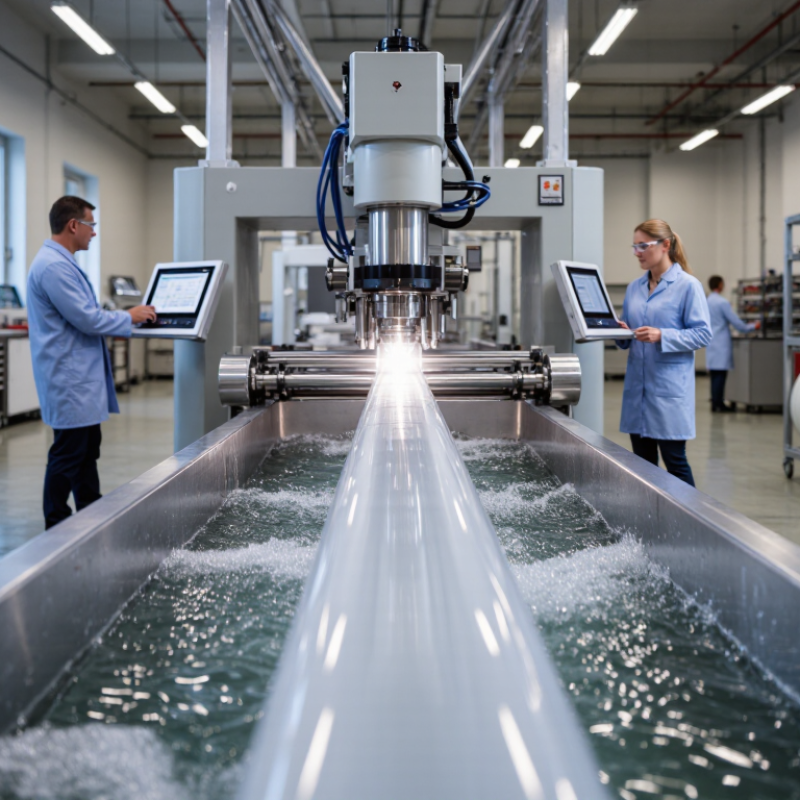
A plastic extrusion line converts thermoplastic material into a continuous product, such as pipe, tubing, sheet, or a shaped profile. The process begins when pellets enter a hopper and drop into a heated barrel. Inside, a rotating screw moves, compresses, and mixes the material until it softens into a consistent melt. Small details matter.
The melt passes through a die, whose opening gives the product its cross-section. Cooling tanks or rollers help the shape hold, while calibration equipment can control dimensions. A haul-off unit pulls the product forward at a steady speed, and a cutter or winder handles the finished length. Then it cools. Operators monitor temperature, screw speed, and product measurements because changes in material or settings can affect the result. A line may appear straightforward, but startup waste and adjustments are real and should be planned for. The best setup depends on the material, required tolerances, output rate, and available floor space. A practical review of those needs can reveal whether extrusion fits the business better than another forming process.
Plastic extrusion turns thermoplastic pellets into continuous shapes by heating, pushing the softened material through a die, and cooling it to size. Common choices include polyethylene (PE), polypropylene (PP), PVC, ABS, and flexible TPU. Each behaves differently under heat and pressure. A resin that works well for a rigid pipe may be a poor fit for a bendable seal.
PE and PVC are widely used for pipes, while PP appears in tubes, channels, and protective profiles. ABS can form tough trim pieces and equipment housings. Extruded sheets may become liners or panels; flexible profiles can serve as edge guards and window seals. Small details matter. Wall thickness, die design, and cooling speed all affect dimensions and surface quality. A profile that looks simple can still warp if cooling is uneven.
Material selection depends on the product’s actual working conditions. Sunlight, cleaning chemicals, repeated bending, and temperature changes can each alter performance. Additives may help, but they need careful evaluation alongside the base resin. Not always. A higher-strength material is not automatically the better choice if it raises cost or makes processing less stable. During production, operators can check sample dimensions and watch for rough edges, color variation, or inconsistent flow—small signs that the process may need adjustment.
A plastic extrusion line gives a manufacturer control over how profiles, sheets, or tubing are made. Pellets are heated, pushed through a shaped die, and cooled into continuous product. That can reduce reliance on outside suppliers and make custom dimensions easier to produce. Die changes and material adjustments still take time, so flexibility is not instant. A practical benefit is repeatability: operators can monitor temperature, pressure, and line speed during production. That matters. PlasticsEurope’s Plastics – the Fast Facts 2023 reports global plastics production of 400.3 million tonnes in 2022, showing the scale of the materials market.
An extrusion line may also support recycled-content products, when the equipment and feedstock are properly matched. The OECD’s Global Plastics Outlook reports that 353 million tonnes of plastic waste were generated in 2019, with only 9% ultimately recycled. This points to a resource challenge, not guaranteed demand for any single product. Recycled feedstock can vary in moisture, melt flow, and contamination, affecting output and scrap rates. Before investing, businesses should compare expected throughput with energy use, labor, die costs, and maintenance needs. A line can sit underused. Forecasts can be wrong, and careful planning cannot remove every production risk.
| Business Dimension | How an Extrusion Line Helps | Useful Performance Measures | Potential Business Benefit | Important Consideration |
|---|---|---|---|---|
| Production Throughput | A continuous process melts, conveys, and shapes material through a die, supporting steady production of products such as pipe, sheet, film, and profiles. | Good output per operating hour; line utilization; unplanned downtime; changeover time. | May support larger or more predictable production volumes when demand and line capacity are well matched. | Actual output depends on resin, product dimensions, die design, cooling, haul-off speed, and operating conditions. |
| Product Consistency | Controlled temperatures, screw speed, pressure, and downstream equipment help maintain product dimensions and surface characteristics. | Dimensional variation; product weight per unit length or area; scrap rate; customer rejection rate. | More consistent output can simplify inspection and help reduce quality-related waste and rework. | Consistency requires suitable process controls, regular calibration, trained operators, and stable raw materials. |
| Product Range and Customization | Changing dies and downstream tooling can enable production of different shapes, sizes, and product specifications on compatible equipment. | Number of qualified products; tooling change time; first-pass yield after changeover. | Can allow a business to serve varied customer requirements and develop additional product lines. | Each product may require dedicated tooling, trials, process settings, and quality approval. |
| Material Efficiency | Process monitoring and optimized start-up and changeover practices can help limit off-spec material. Regrind may be usable for some products when specifications permit. | Material yield; scrap by cause; start-up waste; percentage of approved recycled or reprocessed content. | Better material utilization may lower material cost per saleable unit and reduce disposal needs. | Reprocessed content must be assessed for contamination, material degradation, product performance, and applicable requirements. |
| Labor and Process Control | Automated controls and monitoring can regulate process settings and support repeatable operation; operators remain important for setup, inspection, and troubleshooting. | Labor hours per unit; operator interventions; alarm frequency; training time. | Automation may improve process visibility and help allocate staff more effectively. | Automation does not eliminate the need for qualified staff, preventive maintenance, or safe operating procedures. |
| Production Planning | In-house production can give a business more direct control over scheduling, order priorities, and product availability. | On-time delivery; lead time; schedule adherence; inventory days. | May improve responsiveness to customer demand and reduce reliance on external production capacity. | Benefits depend on reliable material supply, maintenance planning, staffing, and sufficient order volume. |
| Operating Cost Visibility | Producing internally makes it possible to track material, energy, labor, maintenance, and quality costs against each product or production run. | Conversion cost per unit; energy per kilogram; maintenance cost; cost of quality losses. | Detailed cost data can support pricing, process improvement, and make-or-buy decisions. | Total cost should include equipment, installation, tooling, utilities, labor, maintenance, and financing—not just the purchase price. |
| Capacity Expansion | Capacity can be planned around required products and volumes, with compatible auxiliary equipment or additional lines considered as demand grows. | Capacity utilization; order backlog; equipment availability; forecast demand by product. | A well-planned investment can create a path to meet future demand and broaden production capability. | Capacity additions should be evaluated against demand forecasts, facility space, utilities, and working capital. |
Note: Benefits and performance outcomes vary with product design, material, equipment configuration, operating practices, and production volume. Evaluate an investment using application-specific trials and a full cost analysis.
Why Choose a Plastic Extrusion Line for Your Business?
Factors to Consider When Choosing an Extrusion System
Start with the product, not the machine. List the resin types, profile dimensions, wall thickness, and tolerances your customers require. A line designed for simple tubing may not handle a wide, thin sheet consistently. Small differences matter.
Estimate realistic output, not just the maximum speed in a brochure. Consider how often you will change materials, colors, or dies, and how much setup time each change requires. Check whether the screw and barrel suit your chosen polymers. Poor material matching can mean uneven melting, surface defects, or avoidable waste. Not always obvious.
Cooling and calibration deserve close attention. A profile may leave the die looking correct, then warp as it cools. Ask how the line controls temperature, puller speed, and sizing. If possible, test your actual material and product dimensions before committing. Trial runs can reveal assumptions that a spreadsheet misses.
Review the full operating cost, including power, staffing, maintenance, and spare parts. Make sure operators can reach routine service points without awkward disassembly. Ask about training and technical support, too. A faster line is not automatically a better investment. The right system fits your product range, floor space, and team—and leaves room for needs you have not fully predicted yet.
Operating and Maintaining a Plastic Extrusion Line
Reliable extrusion depends on small, repeatable checks. Operators can log melt temperature, screw speed, head pressure, and output at set intervals. Changes in these readings may reveal process drift before it produces a full batch of off-spec material. Small pauses matter.
At start-up, confirm cooling-water flow, inspect the screen pack, and raise throughput gradually. Keep moisture-sensitive resin dry according to its material specification; excess moisture can cause bubbles or rough surfaces. Routine checks should cover heater bands, thermocouples, gearbox oil, screw and barrel wear, guards, and emergency stops. Follow the machine manual, but adjust inspection frequency when material, output, or operating conditions change.
Compressed air deserves attention where the line uses pneumatic equipment. The U.S. Department of Energy’s Improving Compressed Air System Performance guide estimates that leaks can waste 20–30% of compressor output. Listen for leaks and record repair dates. Plastics Europe reported 413.8 million tonnes of global plastics production in 2023, a useful reminder of the sector’s scale, not a forecast for any single plant. A checklist helps, but it can still miss gradual wear. Reviewing scrap, downtime, and energy use per kilogram each week gives the team a chance to question routines that no longer fit the line.
Extrusion lines can process a range of polymers, each requiring an appropriate temperature window. The ranges shown are indicative industry examples; actual settings vary by material grade, equipment, and product design. Follow the material supplier’s processing guidance and your equipment manufacturer’s recommendations.
It forms continuous products such as pipes, tubing, sheets, and shaped profiles. The die sets the cross-section.
Pellets fall from a hopper into a heated barrel. A rotating screw moves and softens them into a melt. The melt passes through a die, then cools as the line pulls it forward.
Cooling tanks or rollers help the shape hold. Calibration equipment controls dimensions, while a haul-off unit maintains steady movement. A cutter or winder handles the finished length.
They track temperature, screw speed, pressure, and product measurements. Small changes can affect the result. That part is easy to underestimate.
Yes. Changing the die or material settings can support different dimensions, but adjustments take time. Flexibility is not instant.
It can, if the equipment and feedstock are well matched. Recycled material may vary in moisture, melt flow, and contamination, which can increase scrap.
Compare expected output with energy use, labor, die costs, maintenance, and available floor space. A line can sit underused.
It can support repeatability when operators monitor the process. Still, startup waste and production changes are real. Forecasts can be wrong.
A Plastic Extrusion Line transforms raw plastic material into continuous products by heating it until it can flow, shaping it through a die, and then cooling and cutting it to the required dimensions. The process can use materials such as polyethylene, polypropylene, and PVC to produce items including pipes, profiles, sheets, films, and tubing. By controlling temperature, pressure, and production speed, businesses can create consistent products for a range of applications.
Investing in an extrusion system can support efficient, high-volume production, reduce material waste, and provide flexibility to make different product sizes and shapes. Before choosing a line, businesses should consider the materials they plan to process, desired output, product specifications, available space, energy use, and budget. Reliable operation also depends on regular maintenance, including inspecting key components, cleaning the equipment, and monitoring process settings. Careful selection and upkeep can help a business achieve dependable production and make the most of its investment.

Baodie