A Pvc Extrusion Machine is used to transform plastic resin into continuous profiles, tubes, sheets, and films. It heats, mixes, and pushes material through a shaped die. The result may become window frames, electrical conduits, medical tubing, flooring, or protective edge strips. In a factory, the process often begins with carefully measured pellets. Operators then monitor temperature zones, screw speed, pressure, and cooling conditions.
The machine’s value depends on control, not only production speed. A stable setup can create consistent dimensions across hundreds of meters. Water tanks cool the hot profile, while haul-off units pull it forward at a controlled rate. Cutters or winders finish the line. Small adjustments matter. A slight temperature change can cause surface marks, bending, weak weld lines, or uneven thickness.
Experienced manufacturers choose equipment according to polymer type, profile size, output targets, and required tolerances. PVC formulations also vary, so one setting cannot serve every product. This is where practical testing becomes essential. Quality teams inspect samples with gauges, visual checks, and, when necessary, laboratory measurements. Even advanced equipment needs skilled operators and regular maintenance. That point is sometimes overlooked. A Pvc Extrusion Machine can improve efficiency, but it cannot correct poor material preparation or careless process control. This guide explains its main uses, working stages, and selection considerations, while recognizing that real production results depend on both technology and disciplined human judgment.
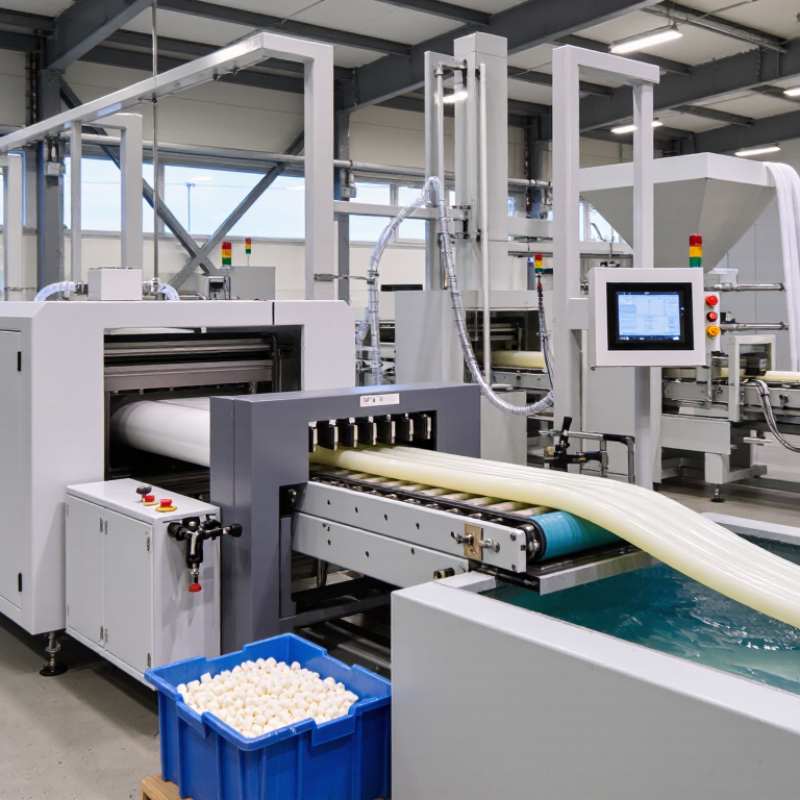
A PVC extrusion machine continuously melts and shapes PVC into pipes, profiles, sheets, and cable conduits. It turns measured pellets or powder into consistent products. In a working line, the hopper feeds material into a heated barrel. A rotating screw mixes, compresses, and pushes the softened PVC forward. The die gives the plastic its final cross-section.
The main components include the feeding system, screw, barrel, heaters, die, calibration table, cooling tank, haul-off unit, and cutter. For hollow products, vacuum calibration helps maintain accurate dimensions. Cooling water removes heat before the product reaches the haul-off.
Even a small temperature change can affect wall thickness. Operators should check melt pressure, screw speed, and cooling flow during each production run.
PVC extrusion machines commonly deliver between 20 and 1,200 kg/h. Smaller systems suit laboratory work, narrow profiles, and limited production. Larger systems handle high-volume pipe or sheet manufacturing.
However, output is never controlled by machine size alone. PVC formulation, moisture, die design, screw geometry, and product dimensions all matter. A catalogue rate can mislead. Real output may fall when tighter tolerances are required. Practical testing remains essential.
One overlooked detail is calibration wear. It can slowly create oval pipes or uneven profiles, even when the machine appears stable.
What Is a PVC Extrusion Machine Used For?
A PVC extrusion machine converts solid PVC pellets into continuous profiles, pipes, sheets, or seals. The process begins in the hopper, where pellets fall into a heated barrel. A rotating screw then carries them forward at a controlled speed. Moisture, dust, and inconsistent pellet size can disturb this simple-looking step. Clean feeding matters.
Inside the barrel, heaters raise the material gradually, usually within 160–210°C. The exact setting depends on the PVC formulation, profile design, and production speed. Heat softens the pellets, while screw rotation adds friction and mixing energy. Operators monitor each barrel zone instead of trusting one temperature reading. PVC can degrade if it stays too hot for too long. It may release corrosive fumes and develop dark streaks.
Homogenization gives the melt a more uniform temperature, color, and viscosity before it reaches the die. A well-designed screw helps disperse additives and reduce unmelted particles. In practical production, pressure stability is a useful warning signal. Sudden changes may indicate bridging, poor feeding, or material buildup. Even experienced operators can misjudge the process when the surface looks smooth. A profile may still contain weak areas inside. Regular checks of output weight, dimensions, and melt pressure improve reliability. The machine is not simply a heater with a screw; it is a controlled system where feeding, melting, mixing, and cooling must work together.
What Is a PVC Extrusion Machine Used For?
A PVC extrusion machine converts a controlled PVC mixture into continuous pipes or profiles. The die is the shaping heart of the process. Melted material enters the die through several flow channels. These channels guide the material around a mandrel for hollow pipe production.
For pipes from 16 to 630 mm, die dimensions must match the target diameter and wall thickness. A small pipe die needs precise flow control because minor changes can affect roundness. Large dies require balanced pressure across a much wider section. The material then passes through a vacuum calibration sleeve. Cooling water fixes the outside diameter while haul-off equipment maintains steady movement. Even a small speed change can create uneven walls.
Profile dies work differently. Their openings may form window frames, cable ducts, seals, or decorative sections. Thin corners and hollow chambers make flow balance more difficult. Engineers often adjust die lips, melt temperature, and cooling conditions during trials. In practice, the first setting is rarely perfect. This is normal. A poorly centered mandrel can cause one side of a pipe to become noticeably thinner. Excessive heat may also damage the PVC surface or reduce dimensional stability. Reliable production depends on die design, material knowledge, regular measurement, and careful operator experience.
PVC extrusion machines use interchangeable dies, sizing sleeves, cooling tanks, and haul-off systems to produce pipes with controlled outside diameters. The chart shows representative metric PVC pipe outside-diameter sizes from 16 to 630 mm. Exact size availability depends on the applicable pipe standard, pressure class, and application. Profile dies use the same extrusion principle but create non-circular shapes such as window frames, channels, and conduits.
A PVC extrusion machine converts heated PVC compound into continuous profiles, pipes, channels, or cable conduits. Its value lies beyond shaping. It controls cooling, dimensions, pulling speed, and final length during uninterrupted production. PlasticsEurope reported that European converters processed 57.2 million tonnes of plastics in 2022. This scale shows why stable extrusion control matters.
After the die forms the hot profile, cooling tanks remove heat through controlled water flow. Calibration sleeves or vacuum calibrators hold the outer dimensions while the material is still soft. Operators monitor water temperature, vacuum pressure, and profile wall thickness. Cooling comes next. If cooling is uneven, one side may shrink faster and create warping. A practical line check uses gauges, laser measurement, and visual inspection near the calibration section.
The haul-off unit pulls the cooled profile at a steady speed. Its rollers must provide grip without leaving marks. A small speed change can alter wall thickness or surface finish. The cutting unit then produces fixed lengths using synchronized saws or planetary cutters. According to a 2023 report from MarketsandMarkets, the global plastic extrusion market is projected to grow steadily through the decade, driven partly by construction and infrastructure demand. That forecast supports continued investment in reliable downstream control. Yet no line is perfect. Dust, worn seals, or unstable compound temperature can still create defects. Skilled operators must question readings, not merely trust them.
What Is a PVC Extrusion Machine Used For?
A PVC extrusion machine melts and shapes PVC into continuous products. Common outputs include pipes, window profiles, cable insulation, sheets, and sealing strips. The machine feeds pellets or dry blend through a heated barrel. A shaped die then forms the hot material. Cooling tanks or calibration units fix the final dimensions.
Single-screw extruders offer steady conveying and relatively simple operation. They suit standard pipes, profiles, and many rigid PVC products. Their simpler design can reduce maintenance demands. However, mixing may be limited when the formulation contains high filler levels or several additives. Operators must watch melt pressure, barrel temperature, and surface quality closely. Small temperature changes can create roughness or discoloration.
Twin-screw extruders provide stronger mixing and more controlled material distribution. They handle complex PVC formulations, recycled feedstock, and products requiring precise additive dispersion. Their intermeshing screws can improve feeding and reduce unmixed pockets. Throughput may be higher, but the system needs careful torque and temperature management. More output is not automatically better. Excessive shear can overheat PVC and damage the melt. A practical line review should compare production rate, mixing quality, energy use, and scrap. I would not choose by screw type alone. Die design, cooling capacity, formulation, and operator experience can change the result.
| Comparison Dimension | Single-Screw Extruder | Twin-Screw Extruder | Typical Selection Guidance |
|---|---|---|---|
| Primary Function | Melts, conveys, and shapes a relatively uniform PVC compound through a die. It is especially effective when the feed material is already well compounded and pelletized. | Conveys, melts, disperses, and homogenizes PVC formulations. The intermeshing screw design provides stronger distributive and dispersive mixing than a conventional single screw. | Choose a single screw for straightforward melt processing; choose a twin screw when compounding and homogenization are important. |
| Common PVC Materials | Rigid PVC pellets, flexible PVC pellets, regrind with consistent quality, and pre-compounded extrusion grades. | PVC powder blends, dry blends containing stabilizers and lubricants, filled formulations, impact-modified compounds, and formulations requiring intensive mixing. | A twin screw is generally more suitable for direct processing of PVC dry blends. |
| Typical Throughput Range | Approximately 20–500 kg/h for many general-purpose profile, pipe, sheet, and film lines. Actual output depends on screw diameter, material, die design, and operating speed. | Approximately 50–1,500 kg/h for many industrial PVC compounding and profile applications. Larger systems can exceed this range with suitable formulation and cooling capacity. | These are practical reference ranges rather than fixed ratings; machine size and formulation determine actual throughput. |
| Mixing Capability | Low to moderate. Mixing can be improved with barrier sections, mixing pins, Maddock-style sections, or static mixers, but excessive shear may increase PVC degradation risk. | Moderate to high. Screw elements can be configured for conveying, melting, distributive mixing, and controlled dispersive mixing. | Use a twin screw for color, filler, additive, or recycled-material uniformity. |
| Plasticization of PVC | Usually requires a stable, pre-compounded feed and careful temperature control. Plasticization depends strongly on screw design, compression ratio, and feed condition. | Provides more active plasticization and residence-time control, making it better suited to PVC powder blends and formulations with varying bulk density. | Twin screw systems offer greater process flexibility when the feed is not already fully compounded. |
| Residence-Time Behavior | Generally straightforward and comparatively easy to predict. A shorter, consistent residence time can support stable production when the feed is uniform. | Residence-time distribution can be managed through screw configuration, fill level, speed, and feed rate. Some configurations provide more processing time for melting and mixing. | Both designs require controlled temperature and residence time because PVC is sensitive to overheating. |
| Shear and Heat Sensitivity | Often provides lower mechanical complexity and moderate shear. It can be advantageous for heat-sensitive PVC when the screw and process settings are correctly matched. | Can generate higher localized shear and mechanical energy, especially with intensive mixing elements. Cooling and screw design must prevent excessive melt temperature. | Select the lowest shear level that achieves the required dispersion and plasticization. |
| Typical Applications | PVC pipe, conduit, cable insulation, tubing, window and door profiles, siding, sheet, film, and simple molded or extruded strips. | PVC profile, pipe, sheet, and pellet production from powder blends; filled profiles; recycled PVC compounds; and products requiring consistent additive distribution. | The die, calibration equipment, cooling system, and haul-off are as important as the extruder type. |
| Energy and Operating Cost | Typically lower capital cost, simpler operation, and lower maintenance complexity for pelletized feedstock and standard extrusion duties. | Typically higher equipment complexity and maintenance requirements, but it can combine compounding and extrusion steps and reduce the need for a separate pre-compounding operation. | Compare total process cost, not only the purchase price of the extruder. |
| Process Control | Common control points include barrel temperature, melt pressure, screw speed, feed rate, and die temperature. The process is comparatively simple for consistent materials. | Requires control of barrel temperature, screw speed, feed rate, torque, melt pressure, fill level, and sometimes multiple feed streams. | Twin screw lines require more process knowledge but offer broader formulation control. |
| Advantages | Simple design, lower initial investment, easier maintenance, steady output, and good suitability for pre-compounded PVC pellets. | Stronger mixing, flexible screw configuration, improved handling of powder blends and additives, and potential integration of compounding and shaping. | Match the machine to the feedstock, required mixing level, output target, and product geometry. |
| Main Limitations | Limited ability to homogenize difficult powder blends, fillers, or recycled materials without additional compounding equipment or specialized screw sections. | Higher capital and maintenance costs, greater control complexity, and potential for excessive shear or temperature if improperly configured. | Correct formulation, screw design, venting, and temperature control are essential for both types. |
Note: Throughput figures are typical engineering reference ranges for PVC extrusion equipment and are not guaranteed machine ratings. Actual performance varies with screw diameter, PVC formulation, bulk density, moisture, die resistance, product geometry, cooling capacity, and operating conditions.
It converts solid PVC pellets into continuous pipes, profiles, sheets, channels, or seals. The process is continuous.
Pellets fall from a hopper into a heated barrel. A rotating screw carries them forward steadily. Moisture, dust, or uneven pellet sizes can disturb feeding.
PVC is usually heated between 160°C and 210°C. The exact temperature depends on the formulation, profile design, and production speed. Too much heat can cause dark streaks and corrosive fumes.
Each zone affects melting and mixing differently. Operators should check several readings instead of trusting one temperature. PVC can degrade when overheated for too long.
Homogenization creates a more even melt temperature, color, and viscosity. The screw disperses additives and reduces unmelted particles. A smooth surface does not always prove internal strength.
The die guides melted PVC around a mandrel to form a hollow pipe. Pipe dies must match the target diameter and wall thickness. The discussed range extends from 16 to 630 millimeters.
Profile dies shape openings for frames, cable ducts, seals, and decorative sections. Thin corners and hollow chambers make flow balance harder. The first setting is rarely perfect.
Cooling tanks remove heat through controlled water flow. Vacuum calibrators or sleeves hold the outside dimensions while PVC remains soft. Uneven cooling can cause warping.
Haul-off rollers pull the cooled product at a steady speed. A synchronized cutter produces fixed lengths. Small speed changes can alter wall thickness or surface finish.
Operators should check output weight, dimensions, wall thickness, melt pressure, and surface quality. Gauges and laser measurements provide useful evidence. Readings can still mislead. Regular human judgment matters.
A Pvc Extrusion Machine is used to produce continuous PVC products such as pipes, profiles, sheets, and specialized sections. In a typical process, PVC pellets are accurately fed into the extruder, heated to approximately 160–210°C, melted, and homogenized to create a consistent material flow. Depending on the equipment design and product requirements, output can range from about 20 to 1,200 kg/h. The molten PVC then passes through a shaped die, forming pipes from 16 to 630 mm in diameter or creating customized profile designs.
After exiting the die, the product is cooled and calibrated to achieve precise dimensions and a stable surface finish. Haul-off units maintain a controlled pulling speed, while cutting systems divide the continuous product into specified lengths. Single-screw extruders are generally suitable for stable, straightforward processing, whereas twin-screw extruders provide stronger mixing and better flexibility for demanding formulations. Their selection depends on material characteristics, production volume, product geometry, and processing requirements.

Baodie