Choosing the right Pipe Extrusion Machine is a production decision, not merely an equipment purchase. The machine must match your resin, pipe diameter, wall thickness, output target, and quality standard. A line designed for PVC may not process HDPE efficiently without different screw geometry, temperature control, and tooling.
Industry data shows why this decision deserves care. PlasticsEurope’s Plastics—The Fast Facts 2024 reported global plastics production of approximately 414 million tonnes in 2023. Plastic pipes remain important in water supply, drainage, agriculture, construction, and infrastructure renewal. Grand View Research also identifies continued growth in the global plastic pipes market, supported by urban development and replacement projects. These reports describe market direction, not a guaranteed return on investment.
Begin with the application. A 20-millimeter irrigation pipe needs a different line balance from a 630-millimeter sewer pipe. Check the extruder’s stable output, melt temperature accuracy, die design, vacuum calibration, cooling length, haul-off grip, and cutting precision. Then examine energy use, spare-part availability, operator training, and local technical support. Small details matter. A poorly matched cooling tank can create ovality, while an undersized motor may struggle during continuous production.
Do not select equipment from catalog output alone. Real output depends on material formulation, moisture, recycled content, tooling, and operating discipline. This is where many evaluations become too optimistic. Request production samples, measured energy data, and references using comparable pipe specifications. ISO 4427, ISO 1452, and relevant regional standards may also influence testing and documentation. The best Pipe Extrusion Machine is not always the fastest model; it is the one that delivers repeatable quality, manageable operating costs, and dependable service over years.
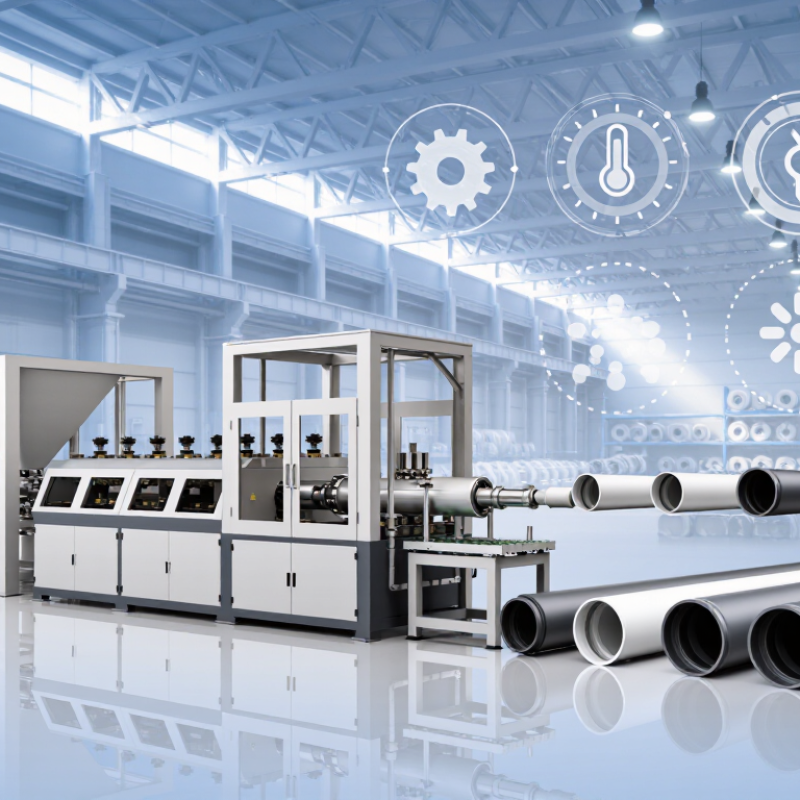
Define the Pipe Product, Material, and Required Specifications
How to Choose the Right Pipe Extrusion Machine?
Define the Pipe Product, Material, and Required Specifications
A reliable machine decision starts with the pipe, not the equipment catalogue. Define outside diameter, wall thickness, length, pressure class, surface finish, and tolerance. Record the application, such as drainage, irrigation, or potable water. Relevant standards, including ISO 4427 for polyethylene pipes, can clarify testing and dimensional requirements.
Material selection changes the entire extrusion process. PVC, PE, and PP require different temperature control, screw designs, dies, and cooling systems. PlasticsEurope’s Plastics—The Fast Facts 2023 reports global plastics production reached 400.3 million tonnes in 2022. That scale does not justify using one machine design for every resin. Recycled content also needs attention. The OECD Global Plastics Outlook reports that only 9% of plastic waste was recycled in 2019. Recycled feedstock can vary in moisture, contamination, and melt flow.
A spreadsheet can still mislead.
Specify the real output rate, not the maximum figure in a brochure. Check screw diameter, length-to-diameter ratio, motor power, die range, vacuum calibration, cooling capacity, haul-off force, and cutting accuracy. A line producing thin irrigation pipe needs different control from one producing thick pressure pipe. Small details matter.
Request trials using the actual resin and target dimensions. Inspect ovality, wall-thickness variation, surface marks, and startup waste. One uncomfortable lesson remains: a lower purchase price may create higher scrap and maintenance costs. Specification gaps are easy to overlook. They are expensive to correct later.
Match Machine Capacity to Pipe Size, Wall Thickness, and Output
Choosing the right pipe extrusion machine starts with the pipe, not the machine’s advertised maximum output.
Define the outside diameter, wall thickness, material, and target production rate.
A 110 mm pipe with an 8 mm wall needs far more torque than a thin irrigation pipe of the same diameter.
The screw diameter and motor power must support stable melting without excessive heat.
Match the die, calibrator, cooling tank, and haul-off to the pipe size.
A larger pipe needs longer cooling time and stronger pulling control.
For example, producing 500 kilograms per hour may require a machine rated slightly higher than that figure.
Real output changes with resin moisture, recycled content, melt temperature, and changeover time.
Maximum output is not daily output.
Ask for a trial using your actual material and wall specification.
Measure kilogram output, diameter tolerance, wall variation, and energy use.
A spreadsheet can mislead.
I once saw a line meet its hourly target but fail because the wall thickness shifted during speed changes.
That result changed the machine selection.
Leave practical headroom, but do not oversize blindly;
an oversized system may waste energy and reduce control at low speeds.
Compare Extruder Types, Components, and Process Control Features
Choosing the right pipe extrusion machine starts with the material, pipe structure, and production target. A single-screw extruder suits many standard thermoplastics and offers steady, simple operation. Twin-screw designs provide stronger mixing for filled, recycled, or modified materials. Co-extrusion systems are useful when pipes need multiple layers, colors, or functional barriers. However, more complexity can mean more maintenance and slower troubleshooting.
The screw, barrel, die, vacuum tank, cooling system, haul-off, and cutter must work as one line. Screw geometry affects melting, pressure, and residence time. Die design controls wall thickness and surface quality. A practical operator checks melt pressure near the die, not only the control screen. Uneven cooling can create ovality, even when the extruder runs smoothly. Small details matter.
Process control features deserve close attention. Independent temperature zones, automatic pressure regulation, gravimetric dosing, and real-time diameter measurement improve repeatability. Data logging helps identify drift before defective pipe fills a storage rack. Strong alarms are valuable, but they cannot replace trained judgment. I once trusted a stable temperature reading while moisture caused surface marks. The machine was not entirely at fault. Ask whether technicians can adjust recipes easily, inspect wear parts safely, and recover production after a fault. A cheaper line may become expensive when calibration, training, or spare components are overlooked.
Evaluate Energy Use, Automation, Maintenance, and Production Reliability
Choosing the right pipe extrusion machine starts with measured production needs, not catalog promises. Record resin type, pipe diameter, wall tolerance, and expected operating hours. A machine running near its stable load usually wastes less energy than an oversized system. Ask for kilowatt-hours per kilogram under comparable conditions. Request test data, not estimates. Check whether heaters, drives, and cooling pumps are monitored separately. This detail reveals where energy disappears during long production runs.
Automation should protect consistency without hiding process problems. Closed-loop controls can adjust temperature, speed, and haul-off pressure when sensors detect drift. However, more sensors do not guarantee better output. Operators still need access to alarms, trend charts, and manual checks. During trials, change one setting and observe the response time. A delayed correction can produce meters of nonconforming pipe. That risk is easy to miss. Choose interfaces that record faults clearly and protect critical settings from accidental changes.
Maintenance planning deserves the same attention as output capacity. Inspect screw wear, heater bands, filters, bearings, and cooling lines before purchase. Ask how quickly routine parts can be replaced and whether service training is available. A clean layout reduces inspection time around the die and drive cabinet. Reliability depends on stable feeding, consistent heat control, and realistic maintenance intervals. Impressive trial runs can hide weak filtration or difficult access. Not always. Use calibrated meters and documented acceptance tests. Run longer trials with planned stops and material changes. The cheapest machine may become expensive when minor faults stop an entire line.
How to Choose the Right Pipe Extrusion Machine?
Evaluate energy use, automation, maintenance requirements, and production reliability before selecting a pipe extrusion system.
The chart uses a 0–100 performance index. Higher scores indicate better energy efficiency, greater automation, lower maintenance burden, and higher production reliability. The comparison reflects common operating ranges for industrial pipe extrusion systems and excludes company or brand-specific data.
Check Supplier Support, Total Cost, Safety, and Future Expansion
How to Choose the Right Pipe Extrusion Machine?
Supplier support should be measured before the machine arrives. Ask for response times, spare-parts availability, remote diagnostics, and technician coverage. Request a written commissioning plan, operator training, and performance tests using your actual resin and pipe sizes. A supplier’s sales promise is not a maintenance strategy. The OECD Global Plastics Outlook (2022) reports that global plastic production reached 460 million tonnes in 2019. Demand is large, but downtime remains expensive.
Compare total cost, not only the quotation. Include electricity, cooling water, tooling, labor, maintenance, rejected pipe, and software updates. The International Energy Agency reports that industry consumed about 37% of global final energy in 2022. An efficient drive, stable temperature control, and reduced startup waste can affect operating profit every month. Still, calculations can mislead. Ask for measured energy data from similar lines, not optimistic estimates.
Safety needs evidence. Use a documented risk assessment aligned with ISO 12100 and verify control-system functions against ISO 13849-1. Check guarding, emergency stops, lockout points, heated zones, and access around the haul-off unit. Walk through a real operator’s shift. Future expansion also deserves floor space, electrical capacity, cooling reserve, and modular tooling. The OECD notes that only about 9% of plastic waste was recycled globally in 2019. Better process control can reduce scrap, although it will not solve recycling alone.
How to Choose the Right Pipe Extrusion Machine? — Check Supplier Support, Total Cost, Safety, and Future Expansion
| Machine Configuration |
Typical Pipe Range |
Common Materials |
Typical Output |
Initial Investment Range |
Estimated 5-Year Total Cost |
Supplier Support to Confirm |
Safety and Compliance Features |
Expansion Potential |
Best Fit |
| Compact Single-Screw Line |
16–63 mm |
PE, PP, PVC compounds |
80–180 kg/h |
US$70,000–140,000 |
US$180,000–330,000 |
Remote commissioning, operator training, spare-parts list, and a recommended start-up inventory.
Verify local service response time.
|
Emergency stops, guarding, overload protection, heater-zone alarms, and electrical documentation.
|
Moderate; downstream equipment can usually be upgraded, but screw and barrel capacity may limit growth.
|
Small production runs |
| Standard Single-Screw Line |
20–160 mm |
PE, PP, PVC, PPR |
180–450 kg/h |
US$140,000–280,000 |
US$340,000–690,000 |
On-site installation, process validation, preventive-maintenance schedule, hotline support, and technician availability.
Strong general-purpose support requirement.
|
Interlocked guards, emergency-stop circuits, temperature deviation alarms, motor protection, and documented lockout procedures.
|
Good; compatible with additional calibrators, larger haul-off units, automatic cutters, and centralized material handling.
|
General-purpose production |
| High-Output Single-Screw Line |
110–630 mm |
PE, HDPE, PP |
450–1,000 kg/h |
US$300,000–650,000 |
US$720,000–1,450,000 |
Process-engineering assistance, installation supervision, production ramp-up support, critical spare parts, and annual service visits.
A formal service-level agreement is recommended.
|
Guarding around high-force haul-off equipment, safety relays, pressure and temperature monitoring, emergency cooling, and documented risk assessment.
|
Very good; suitable for multiple downstream lines, automation, gravimetric dosing, recycling integration, and production monitoring.
|
High-volume utility pipe |
| Co-Extrusion or Multi-Layer Line |
16–1,000 mm |
PE, PP, PVC, recycled-content structures |
250–900 kg/h |
US$450,000–1,100,000 |
US$1,000,000–2,300,000 |
Material compatibility testing, layer-thickness validation, recipe management, advanced training, remote diagnostics, and application engineering.
Require documented acceptance testing.
|
Independent emergency stops, guarded dosing systems, melt-pressure alarms, recipe access control, electrical safety verification, and machine-risk documentation.
|
Excellent; supports barrier layers, recycled-content layers, color layers, additional extruders, and upgraded control systems.
|
Specialized and future-focused products |
FAQS
A single-screw extruder often suits standard thermoplastics. It provides steady operation and simpler maintenance. Keep the process practical.
Twin-screw designs offer stronger mixing for filled, recycled, or modified materials. They may increase maintenance and troubleshooting time.
Co-extrusion creates multiple layers, colors, or functional barriers. It adds flexibility, but the line becomes more complex.
The screw, barrel, die, vacuum tank, cooling system, haul-off, and cutter form one production line. One weak section affects the whole pipe.
Check melt pressure near the die, not only the control screen. Inspect wall thickness, cooling balance, diameter, and surface appearance.
Independent temperature zones, pressure regulation, gravimetric dosing, and real-time diameter measurement improve consistency. Data logging can reveal drift early.
Request response times, spare-parts availability, remote diagnostics, technician coverage, and operator training. Ask for tests using your actual resin and pipe sizes.
Include electricity, cooling water, tooling, labor, maintenance, rejected pipe, and software updates. Measured energy data is better than optimistic estimates.
Check guarding, emergency stops, lockout points, heated zones, and haul-off access. A documented risk assessment should support the design.
Reserve floor space, electrical capacity, cooling capacity, and modular tooling. Expansion plans often look simple on paper. Reality can disagree.
Conclusion
Choosing the right Pipe Extrusion Machine starts with a clear understanding of the pipe product, including its material, diameter, wall thickness, length, surface quality, and required standards. The machine’s capacity should match the planned pipe sizes and production output, while the extruder type, screw design, die, cooling system, haul-off, and cutting unit should suit the material and processing conditions. Reliable process control is also essential for maintaining stable dimensions and consistent quality.
Beyond basic performance, evaluate energy efficiency, automation level, ease of maintenance, and long-term production reliability. A practical selection should include an assessment of installation requirements, operator safety, spare parts availability, technical support, total operating cost, and expected service life. It is also wise to consider future expansion, such as higher output, additional materials, or new pipe specifications. By comparing these factors carefully, manufacturers can select equipment that supports efficient production, reduces avoidable downtime, and delivers consistent results over time.

 Baodie