2026 Top PE Pipe Extrusion Line Manufacturers?

Time:2026-09-30 Author:Sophia
0%

The 2026 search for leading Pe Pipe Extrusion Line manufacturers requires more than comparing catalog prices. Buyers should examine output stability, energy use, automation, service coverage, and compliance with recognized pipe standards. A polished brochure proves little.

Industry demand remains substantial. PlasticsEurope reported global plastics production of approximately 413.8 million tonnes in 2023, showing the scale of the wider plastics sector. Meanwhile, market studies from Grand View Research and Fortune Business Insights forecast continued growth in plastic pipes, supported by water infrastructure, gas distribution, irrigation, and industrial construction. Forecasts differ, however. Their figures depend on regional coverage, product definitions, and installation trends.

Technical performance matters on the factory floor. A reliable line should maintain consistent wall thickness, melt temperature, haul-off speed, and cooling conditions. Operators often notice problems first at the vacuum tank, sizing sleeve, or cutter. Small instability can create ovality, scrap, and delayed deliveries.

This guide evaluates manufacturers through measurable factors. These include screw design, extruder control, diameter range, output capacity, recycling options, commissioning support, and spare-parts response. Compliance references such as ISO 4427, ASTM F2620, and the Plastics Pipe Institute’s PE guidance provide useful benchmarks for polyethylene pipe production.

No ranking is perfect. Some suppliers publish detailed test results, while others reveal limited factory data. That gap deserves caution. A serious comparison should include witnessed trials, sample inspection, energy measurements, and references from comparable plants. The strongest 2026 candidates will combine dependable engineering with transparent evidence, not merely impressive claims.
2026 Top PE Pipe Extrusion Line Manufacturers?

PE Pipe Extrusion Lines: Definition, Applications, and Key Components

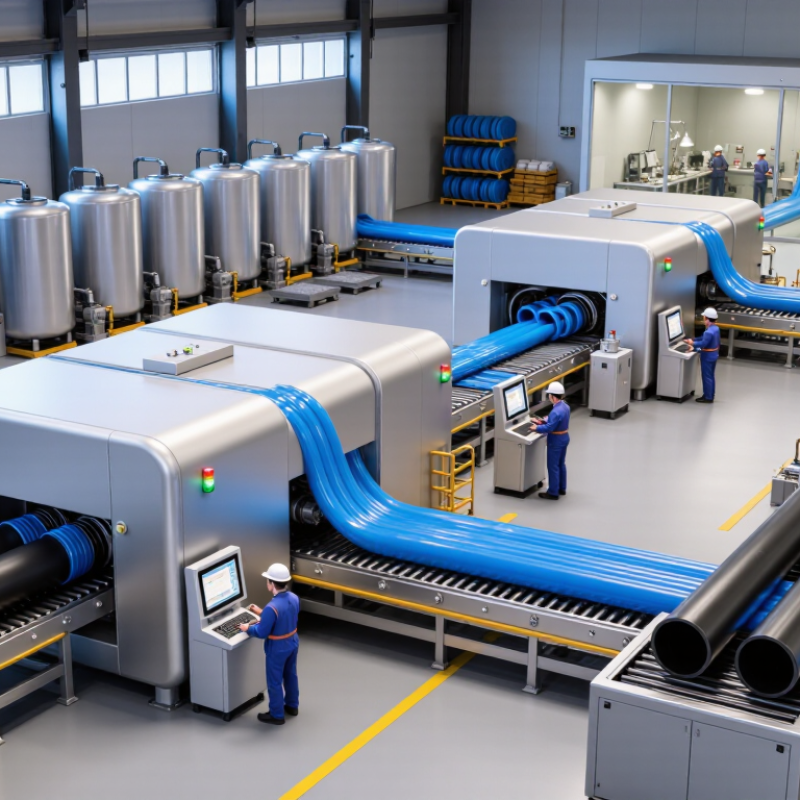
A PE pipe extrusion line is a coordinated system that melts polyethylene, shapes it through a die, and cools it into a continuous pipe. The extruder’s heated barrel and rotating screw soften and mix resin pellets. Temperature, screw speed, and material feed must stay stable. A die forms the pipe’s diameter and wall profile, while a vacuum sizing tank helps hold its shape. Cooling tanks then lower the pipe temperature in stages.

The line also includes a haul-off unit, cutting equipment, and controls for monitoring production. Each part affects the next. Details matter. A weak haul-off setting, for example, can stretch warm pipe and change its dimensions.

PE pipes are commonly used for water distribution, drainage, irrigation, and gas networks, where flexibility and corrosion resistance are useful. Operators check wall thickness, surface finish, and diameter during production rather than relying only on machine settings. Even a well-configured line needs adjustment when resin grades, pipe sizes, or ambient conditions change.

That variability is easy to underestimate. Extrusion is continuous, but quality checks should not be.

How to Evaluate PE Pipe Extrusion Line Manufacturers in 2026

Evaluating PE pipe extrusion line manufacturers in 2026 requires more than comparing prices. Grand View Research estimates the global plastic pipes market will expand at about 4.8% annually through 2030. Demand alone does not prove equipment quality. Ask for verified output data, energy consumption, scrap rates, and pipe-dimension records from comparable projects.

A reliable manufacturer should explain how its extruder, die, vacuum tank, haul-off, and cutting system maintain stable wall thickness. Request factory acceptance testing with your resin grade and target diameter. Check compliance with ISO 4427, ISO 12162, and applicable national standards. Production experience matters. A line producing 1,000 kilograms per hour may perform poorly with recycled content or frequent diameter changes.

MarketsandMarkets reports continued investment in plastic pipe production, but published forecasts vary. That is worth remembering. Some reports use different regional definitions and market categories. Visit an operating factory if possible. Inspect the control cabinet, cooling-water cleanliness, screw wear, and maintenance records. Ask for actual uptime over twelve months, not a perfect demonstration.

Service quality can decide the real cost. Confirm spare-part availability, remote diagnostics, installation training, and response times. Calculate energy use per kilogram, not only installed motor power. I would also question unusually high guarantees. They may hide strict material or speed conditions. A detailed contract should define acceptance tolerances, testing methods, and remedies for missed performance.

2026 Top PE Pipe Extrusion Line Manufacturers? - How to Evaluate PE Pipe Extrusion Line Manufacturers in 2026

Manufacturer evaluation matrix for polyethylene (PE) pipe extrusion lines. Use the criteria and weights below to compare suppliers against the same pipe specification, resin, and production conditions.

Evaluation dimension What to compare and verify Practical evaluation benchmark Weight
Pipe range and application Quoted outside-diameter range, wall-thickness range, PE material grades, and intended use, such as water, gas, or industrial piping. Confirm that the proposed line covers the buyer’s full product schedule, including the required SDR classes and the smallest and largest pipe sizes. 12%
Rated output and production guarantee Guaranteed output in kg/h for each agreed pipe size, material grade, and wall thickness; include start-up scrap and stable-production conditions. Request a written guarantee tied to a defined resin and pipe specification. Compare like-for-like test conditions rather than headline maximum output. 15%
Pipe dimensional control Vacuum calibration, cooling capacity, haul-off stability, wall-thickness measurement, and control of outside diameter and ovality. Require a witnessed production test with documented measurements against the buyer’s applicable product standard and tolerances. 13%
Extruder and screw design Screw and barrel materials, screw geometry, drive rating, melt-temperature control, and the supplier’s resin-processing recommendations. Ask for a technical explanation of how the configuration supports the specified PE grade and guaranteed output; verify component specifications in the quotation. 10%
Applicable pipe standards Controls and process capability relevant to the buyer’s required product standards, such as ISO 4427 or EN 12201 for water systems and ISO 4437 or EN 1555 for gas systems. Confirm the exact standard and edition required in the destination market. The line itself does not certify the finished pipe; product testing and certification are separate. 10%
Energy and utilities Installed electrical load, typical power consumption during production, cooling-water demand, compressed-air needs, and any stated energy-per-kilogram figure. Compare measured or guaranteed consumption under the same output and product conditions. Request the measurement method and assumptions behind any energy claim. 8%
Automation and traceability Recipe storage, alarm history, production data export, measurement-system integration, remote diagnostics, and access controls. Verify the functions in a live demonstration and confirm which hardware, software licenses, and data connections are included in the quoted scope. 7%
Line configuration and scope Extruder, die head, vacuum and cooling tanks, haul-off, cutter or coiler, printer, measurement equipment, and required downstream handling. Use a written scope list to identify included equipment, excluded utilities, installation work, tooling, and any items priced separately. 7%
Factory acceptance and commissioning Factory acceptance test (FAT), site acceptance test (SAT), installation supervision, operator training, and documented performance results. Agree on acceptance criteria, test duration, product sizes, output, quality measurements, and remedies for unmet guarantees before placing the order. 7%
Warranty and service support Warranty duration and start date, response channels, service coverage, spare-parts availability, troubleshooting support, and escalation process. Request a written warranty and service plan. A 12-month warranty from commissioning is a useful RFQ comparison point, not a universal market rule. 6%
Total cost of ownership Equipment price plus tooling, freight, duties, installation, training, utilities, wear parts, maintenance, and expected downtime. Compare total ownership costs over the same evaluation period and production assumptions, not purchase price alone. 5%

Scoring method: Score each dimension from 1 to 5 using verified quotation details, test records, and references. Multiply each score by its weight to compare shortlisted offers. Benchmarks are procurement guidance; final requirements depend on the pipe specification, local regulations, and contract terms.

Leading PE Pipe Extrusion Line Manufacturers and Their Strengths

2026 Top PE Pipe Extrusion Line Manufacturers?

Leading PE Pipe Extrusion Line Manufacturers and Their Strengths

Strong PE pipe line manufacturers distinguish themselves through process control, practical engineering, and responsive technical support. Their equipment typically combines a stable extruder, accurate dosing, vacuum calibration, cooling tanks, haul-off units, and cutting systems. Each stage matters. A small fluctuation in melt temperature can affect wall thickness and surface finish.

Some manufacturers specialize in high-output systems for large-diameter pipes, while others offer flexible lines for several pipe sizes. Look closely at screw design, motor capacity, and the calibration tank’s ability to hold steady vacuum. Ask for production data using the intended resin and pipe dimensions. A polished showroom demonstration is useful, but a material-specific trial tells more. Numbers need context.

Service capability is another real strength. Experienced suppliers can help operators set temperatures, adjust haul-off speed, and diagnose uneven pipe walls during commissioning. Check spare-part availability and the clarity of operating manuals before purchase. Ask for references from factories running comparable shifts and products. Even then, performance depends on installation and operator skill. No line is perfect. I would also question unusually high output claims unless the test conditions are clearly stated.

Production Technology, Quality Standards, and Customization Options

A capable PE pipe extrusion line should deliver steady output, accurate dimensions, and reliable melt control. In 2026, buyers should look beyond headline capacity. Ask how the system maintains wall thickness when screw speed changes, and whether its cooling tanks suit the pipe diameters you actually produce. A stable vacuum calibration unit, accessible controls, and clear alarm records can make daily operation more predictable. Small details matter. A poorly placed sensor can slow troubleshooting.

Quality standards need to be verifiable, not just mentioned in a brochure. Review inspection procedures for diameter, ovality, wall thickness, and pressure performance. Request sample production records and ask how calibration is checked. Confirm that electrical components and guarding meet the requirements for your installation site. A factory visit or witnessed trial can reveal practical issues, though one successful run cannot guarantee long-term performance. That limitation is easy to overlook.

Tips: Share your target resin grades, pipe range, shift pattern, and expected output before requesting a quotation. Ask for changeover times, spare-parts lists, training, and service response details. Customization may include screw design, haul-off units, cutting systems, or data logging. Keep the specification realistic; extra features can add cost without improving your process. One useful question: how will the supplier measure success after installation?

Costs, After-Sales Support, and Selection Criteria for Buyers

2026 Top PE Pipe Extrusion Line Manufacturers?

For buyers, the best manufacturer is not always the lowest-priced supplier. A PE pipe extrusion line may cost between USD 80,000 and USD 600,000, depending on diameter range, automation, output, and testing equipment. Ask for a complete quotation. It should include the extruder, dies, vacuum tank, cooling system, haul-off, cutter, control cabinet, installation, and operator training.

After-sales support often determines real production costs. During factory evaluations, check response times, spare-parts availability, and remote troubleshooting procedures. A reliable supplier should provide electrical drawings, maintenance schedules, and clear warranty terms. Request references from plants using similar pipe sizes. Speaking with an actual operator can reveal issues that brochures hide. Sometimes, a cheaper line creates higher downtime costs.

Selection should match your production plan, not a sales demonstration. Review resin grades, target output, wall-thickness tolerance, and local power conditions. Ask whether technicians can install the line on-site and train staff in practical settings. Confirm software language, safety documentation, and access to replacement heaters, sensors, and screws. The strongest manufacturer usually explains limitations openly. That matters.

Buyers should also inspect machine construction before signing. Check frame welding, cooling-water circulation, cabinet labeling, and component accessibility. A technically impressive line may still be inconvenient to clean or repair. I would leave room in the budget for commissioning delays and spare parts. That assumption is not perfect, but ignoring it can be expensive.

FAQS

What is a PE pipe extrusion line?

It melts polyethylene pellets, forms the melt through a die, and cools it into continuous pipe. The process runs continuously. Temperature, screw speed, and material feed must remain stable.

Which components shape and cool the pipe?

The extruder softens and mixes the resin. The die sets diameter and wall profile. A vacuum sizing tank stabilizes the shape. Cooling tanks reduce temperature in stages.

What applications suit PE pipes?

PE pipes commonly support water distribution, drainage, irrigation, and gas networks. Their flexibility and corrosion resistance are useful in buried systems. Application requirements still need careful checking.

How can operators maintain accurate pipe dimensions?

Operators should check diameter, wall thickness, ovality, and surface finish during production. They should not trust machine settings alone. A weak haul-off can stretch warm pipe and change its size.

What should buyers examine beyond production capacity?

Ask how wall thickness remains stable when screw speed changes. Check whether cooling tanks match your actual pipe diameters. Accessible controls and clear alarm records can simplify daily troubleshooting.

How can a buyer verify quality claims?

Request inspection procedures, calibration records, and sample production data. Review pressure performance and dimensional checks. A witnessed trial helps, but one successful run proves little.

What information should be shared before requesting a quotation?

Share resin grades, pipe sizes, expected output, and shift patterns. Ask about changeover time, spare parts, training, and service response. Missing details can produce an unrealistic specification.

Which customization options may be useful?

Options may include screw designs, haul-off units, cutting systems, and production data logging. Choose features that solve a real process problem. More features do not always improve results. That deserves reflection.

Conclusion

This guide explains what a Pe Pipe Extrusion Line is, how it works, and where it is used in water supply, drainage, gas distribution, irrigation, and industrial piping. It reviews the main components, including the extruder, die head, sizing and cooling systems, haul-off unit, cutting equipment, and control system. Readers will also learn how to evaluate manufacturers by examining engineering experience, production capacity, equipment stability, energy efficiency, safety features, and the ability to provide complete line solutions.

The article compares manufacturer strengths through production technology, quality control, applicable standards, automation, and customization options for different pipe sizes and materials. It also discusses investment costs, operating efficiency, spare parts availability, installation, training, warranty terms, and long-term after-sales service. These factors help buyers make a practical decision based on product requirements, budget, expected output, facility conditions, and total ownership value rather than focusing only on the initial purchase price.


Sophia

Sophia

Sophia is a dedicated marketing professional with an exceptional depth of knowledge about her company's products and services. With a keen understanding of market trends and customer needs, she crafts insightful blog posts that not only inform but also engage readers, enriching the company’s online......